Nature and seasons · 10 min read
Wildlife of Kalbarri National Park
Echidnas on the verge, kangaroos at dusk, birds on the cliff and the river, rare fauna mentioned without a treasure-hunt, and why 1080, no dogs and slow dawn driving are part of the same visit.
Editorial desk · Updated 2026-09-18
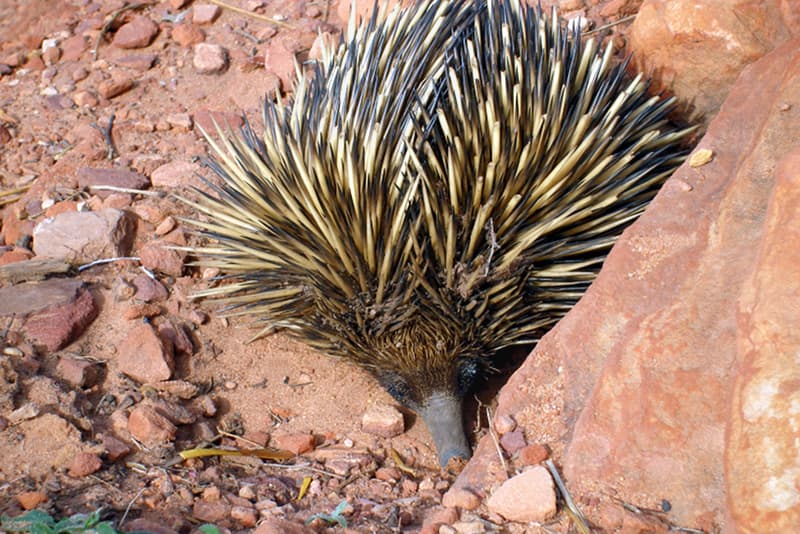
Photo: Brian W. Schaller · Free Art License · Wikimedia Commons. Source file · Free Art License

Brian W. Schaller · Free Art License
Home / Visitor guides / Nature and seasons
Kalbarri National Park is not a safari. It is 186,000 hectares of sandstone plateau, river gorge and coastal heath on Nanda Country, about 590 kilometres north of Perth. Some of that life is easy to meet — a kangaroo on the town verge at dusk, an osprey over the cliffs, an echidna on a warm road. Some of it is barely there for visitors at all. The useful skill is knowing the difference, so you do not invent a treasure hunt and so you do not hit the kangaroo you came to see.
This is an independent journal, not Parks and Wildlife. Baiting programs, track closures and fire work change. Check Explore Parks WA and DBCA alerts before you go. Inland sites use a standard park pass — last-checked $17 a standard vehicle, $10 concession. Coastal lookouts are generally free. Verify both in the fees guide. No drinking water in the park. No casual camping. No dogs.
Echidnas — the one everyone hopes for
The short-beaked echidna is the animal that turns a lookout stop into a story. They are not rare in the brochure sense, and they are not common in the zoo sense. You meet them by luck: a dark shape on a track, a face in the heath, a pause in the middle of a bitumen stub. They eat ants and termites. If you keep quiet and give them room, you may get a minute. If you encircle them with phones, they become a ball of spines in a hole.
Do not pick one up. Do not poke one for a better face. Wait for it to finish crossing rather than becoming a traffic problem yourself. The photograph you want is in the photography guide; the manners are here. Brief children in the car. This is warm country — watch where you put hands and feet.
Kangaroos, wallabies and the large shapes at dusk
Western grey kangaroos are the large mammals most visitors actually see, often not in the “park” at all but on the edges of town, on golf-adjacent grass, on the verges of the gorge road as the light goes. Euro or wallaroo country exists in the rockier inland; most people will not separate the species and do not need to. What they need is a slower right foot.
A kangaroo feeding on a verge will look settled until it is not. Dawn and dusk are the worst hours and the best hours. If you have timed a sunset lookout, you have also timed the drive back for collision weather. Leave more minutes than the map suggests. High beam when you can. Do not overtake into a dark shoulder.
Do not feed them. Do not walk up to a large male for a selfie. Habituated kangaroos near town are still strong animals. If you want the inland landscape they live in, the inland gorges notes will get you to the rim without turning the walk into a chase. Emus turn up; give them the same space.
Birds — cliffs, river and heath
Kalbarri is a bird place even when it is not a mammal place. The cliffs carry sea birds and the hunters that use the updrafts — ospreys, the occasional white-bellied sea-eagle. The gorge has honeyeaters, wrens and raptors on the same thermals that make a summer rim walk feel like a mistake. You need to stand still.
A lookout railing is a hide if you treat it as one. Ten quiet minutes at Eagle Gorge or Natural Bridge beat a rushed string of car-park slams. The same is true at the Skywalk — kaju yatka. Birds sit out the worst heat. So should you.
Flower season — peak August to October — is also bird season in a practical sense, because nectar shrubs are working. That is a reason to walk slowly on the wildflower paths, not a reason to leave them. Stay on the track. The honeyeater does not need you in its bush.
We will not print a full bird list. It would be wrong by next season and it would send people off-track looking for a name. Take a field guide if you enjoy it. Take the visitor centre’s current gossip. Take binoculars before you take a longer lens you will not hold still in the wind.
Rare fauna, mentioned carefully
Kalbarri has, over the years, been associated with mammals most visitors will never see. The western pebble-mound mouse is the example this desk will actually name, and only to make a point. It is a small, unobtrusive animal known from pebble mounds in arid and semi-arid country. It is not a lookout species. It is not something a family walk is going to deliver because a caption mentioned it. If current science and the department still list it among the park’s fauna, that is a conservation fact, not an itinerary item.
Other rare or shy species belong to the same category. Mentioning them is how some writers fill space. Hunting them is how visitors damage habitat. If you are not a licensed researcher, you do not have a project here.
Malleefowl are the rare-adjacent bird people reasonably hope for on the Meanarra hill loop. Hope is allowed. Expectation is how loops get braided with extra pads. See the Red Bluff and Meanarra notes and treat a mound, if you see one, as a structure you do not climb.
If a tour promises “guaranteed rare wildlife”, walk away. The honest product is country, and the animals that happen to be using it.
1080, no dogs, and why the van is not a loophole
Western Shield is the department’s long-running baiting program against foxes and feral cats. The baits use 1080, a poison that is lethal to dogs and to the introduced predators it is aimed at. The baits are laid in this park. The “no dogs” rule is not a vibe and it is not about tidy picnic lawns. It is how native mammals keep a chance, and how your kelpie stays alive.
Pets are banned everywhere in the park, including inside vehicles. “They’ll stay in the van” is how dogs die in heat. This applies to the generally free coastal lookouts as well as the inland gorge. Do not touch baits. If you find something that should not be there, use the park phone — 08 9937 1140. We are not the department.
Dawn, dusk and the rest of a careful day
The hours that show you animals are the hours that put them on the road. Plan the day so you are not surprised by that. A pre-dawn run to beat the Loop heat rule is also a kangaroo shift. A sunset at the stacks is also a dusk drive. Build the extra time in. If you are tired, skip the last lookout.
Walk quietly. Do not play bird-call apps into a gorge. Do not feed anything. Carry the water you need — there is none in the park. In flower season, stay on the path. Hutt Lagoon is not in this park. Lucky Bay camping is outside the boundary. Sleep in town. The visitor guide keeps the logistics honest; best time to visit keeps the season honest. Read Nanda Country before you treat any of this as empty scenery. Coastal cliffs if you want sea birds; geology if the animals and the rock have started to look like the same country.
Look, then leave them to it. Verify fees and alerts before you go. The wildlife does not need you to complete a list. It needs you to keep the dog at home and the car below the speed you had in mind.
Frequently asked questions
- Why are dogs banned in Kalbarri National Park?
- Pets are banned everywhere in the park, including inside vehicles. Western Shield 1080 baits are laid for foxes and feral cats, and 1080 is lethal to dogs. The ban also protects wildlife from disturbance. There is no “they’ll stay in the van” exception worth testing.
- What animals are you likely to see?
- Western grey kangaroos on verges and at dusk, birds on the cliffs and in the river country, and — if you are lucky and quiet — a short-beaked echidna. Treat anything rarer as a bonus, not a booking. Dawn and dusk are the hours that work, and the hours that put animals on the road.
- Is it safe to drive at dusk in and around the park?
- It is the most dangerous ordinary thing most visitors do. Kangaroos feed on verges and cross without warning. Slow down, use high beam when you can, and do not treat a sunset lookout as a reason to hurry back to town in the dark.