Nature and seasons · 9 min read
Visiting Kalbarri on Nanda Country
A visitor’s essay on arriving as a guest on Nanda Country — reading the Skywalk with care, refusing invented ceremony, and leaving the gorge quieter than you found it.
Editorial desk · Updated 2026-10-10
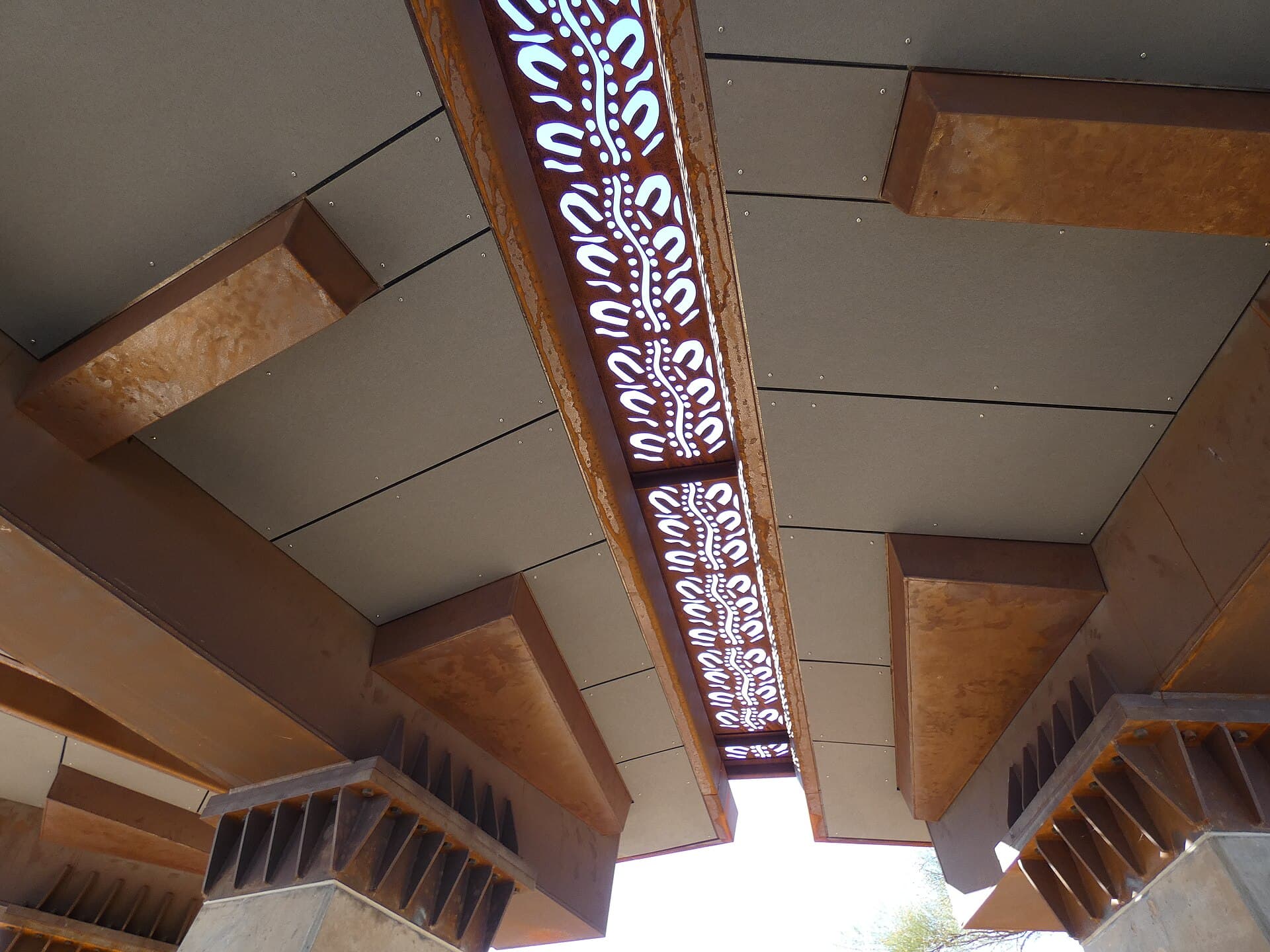
Photo: Findlay Osborn · CC BY-SA 4.0 · Wikimedia Commons. Source file · CC BY-SA 4.0

Findlay Osborn · CC BY-SA 4.0
Home / Visitor guides / Nature and seasons
Kalbarri National Park is Nanda Country. That sentence is not a preface on the way to Nature’s Window. It is the first fact of the place, older than the park boundary and older than the town at the river mouth. You arrive as a guest. The sandstone, the heath and the Indian Ocean cliffs were already spoken for.
This journal is not a Native Title document and it is not a Nanda publication. We do not sell culture, invent a “Dreamtime story” for atmosphere, or pretend a two-hour visit makes you a local. Respect here is a set of ordinary habits: read the signs, stay on the path, pay the inland fee, carry your water, and do not treat living people as scenery.
Verify fees, heat closures and track alerts with Explore Parks WA and DBCA alerts before you leave town. The park sits about 590 kilometres north of Perth. Kalbarri town is the base. There is no casual camping inside the national park, no drinking water on the walks, and no dogs — not even waiting in the car.
Arriving as a guest, not a collector
Most people come for a photograph. Nature’s Window frames a bend of the Murchison so neatly it has become a national screensaver. Kalbarri Skywalk — kaju yatka — throws two steel platforms over a hundred-metre drop. The coastal stacks catch last light like cut stone. None of that is empty. The names on the boards, the plants you crush if you shortcut a corner, and the river itself sit inside a living relationship that did not begin when Parks and Wildlife gazetted a reserve.
Stop saying “the wilderness” as if nobody was here. Nanda people have been here. The park is a management layer over Country that still has owners. Behave as you would in a house you were invited into. Do not chip souvenirs from the rim, stack cairns, or fly a drone over a family on the Skywalk because the light was good. Do not ask a ranger or a café worker to “tell you a Dreamtime story” as if culture were a menu.
If you want first-day logistics, start with the visitor guide and the town as a base brief. Culture is not a separate attraction you bolt onto a Loop walk. It is the ground under both.
What the Skywalk actually offers
The most careful public interpretation many visitors will meet is at Kalbarri Skywalk. The walk from the car park is short, level and designed so that people using wheelchairs, prams and tired knees can reach the rim without a scramble. That accessibility is itself a welcome: more guests can stand over the gorge without being sorted by fitness.
Look up as well as out. The roof carries artwork that is not generic “Indigenous patterning” from a fit-out catalogue. It is part of how this lookout was made on this Country. Read the panels longer than it takes to get a group shot on the glass. You do not need to repeat every word in a caption. Let the work do its job.
kaju yatka is commonly glossed as “walk to sky”. Use the name if you use the place. Do not embroider it, and do not invent a ceremony that “used to happen on this exact cantilever”. The platforms are new. The gorge is not. Holding those two facts at once is the beginning of visiting well.
The Skywalk is an inland site. Last we checked, inland gorge entry was the standard WA park fee — $17 a vehicle, $10 concession — and the coastal lookouts south of town were generally free. There is no second Skywalk ticket. Confirm live figures in the fees guide and on the department pages the morning you drive inland. Platform notes sit in the Skywalk guide.
Do not invent ceremony
Australian travel writing has a bad habit. It reaches for smoke, ochre and a vague “spiritual experience” whenever the light turns red. That habit flattens living law into mood lighting and puts words in mouths that never offered them.
This desk will not describe restricted knowledge, summarise Nanda cosmology, or tell you which rock is a being and which is “just geology”. If a public event or tour is offered by Nanda people or through official park channels, take it on the terms given that day. If nothing is offered, the absence is not a gap you fill with a playlist and a smudge stick bought in Fremantle.
Interpretive art is for looking, not automatically for close-cropping and selling. People on Country are not extras. Children are not props. If a sign says no photography, believe it. Use the names on the boards. If a Nanda name is given, prefer it alongside the English one. If a name is not given, do not mint one.
How to visit well in ordinary hours
Respect is mostly logistics. Fill every bottle in town; there is no drinking water in the park. Unhitch caravans and trailers before the inland Loop and Z-Bend roads — they are banned on those alignments. Leave dogs elsewhere. Western Shield 1080 baits are laid for foxes and feral cats, and pets are not permitted in the park, including inside vehicles. Sleep in Kalbarri, not in a quiet pull-bay you found on a blog.
Walk the short things as if they mattered. Nature’s Window is 30–45 minutes, not a reason to stand on the arch. The Loop is three to five hours with a summer 7 am start rule from November to March; it is not a longer selfie. The coastal cliffs are generally free and still able to kill you in a wave surge. Stay on paths and boardwalks. Carry rubbish out. Do not build new fireplaces.
Lucky Bay is outside the national park: first-come, rules change, phone 08 9937 1140. Hutt Lagoon, the pink lake, is not in the park at all. Do not fold it into a “park day”. That split is unpacked in one park, two landscapes.
If you are travelling with children, keep inland to the Skywalk and the Window and skip the Loop in heat. The family notes are blunt on cliff edges and water. If you only have a day, the itineraries will tell you to stop collecting lookouts.
Listening is a skill
The visitor centre in town is a better first stop than a sunrise dash to the Window. Maps, the week’s wildflower grapevine, and someone who has watched the weather beat a downloaded list. Rangers and desk staff are not obliged to perform culture for you. They can tell you whether a track is closed. That is already a gift.
Listen to the signage in the order it was written. The heat warning at the Loop car park is not decorative. The baiting notice is not optional. The request to stay off fragile rock is not a hint for photographers who “know what they are doing”. Our photography guide is explicit: the arch is thinner than your ambition.
Season changes the mood of Country without changing who it belongs to. Winter and early spring can put colour through the heath. Summer turns the gorge into a furnace that has sat near 50 °C while the town forecast looks merely unpleasant. The best time to visit piece is about heat and flowers, not a more authentic month. There is no off-season in which you stop being a guest.
We will not offer a pronunciation guide scraped from a forum, publish a list of sacred sites, or tell you that standing on the Skywalk is “the same as” a ceremony. The acknowledgement is about Nanda Country, not about our sensitivity.
Reduce the noise you bring. Arrive from town with water and a pass. Read the Skywalk as a made place, not a thrill ride. Leave the Window without climbing it. Pay the inland fee when you use the inland roads. Check Explore Parks WA and the alerts page again if a heat warning lands. Nanda Country does not require your performance. It requires your manners. The gorge will still be there after you drive the 590 kilometres back toward Perth. Whether it is slightly less damaged for your having come is the only review that matters.
Frequently asked questions
- Whose Country is Kalbarri National Park on?
- Kalbarri National Park and the town sit on Nanda Country. Nanda people are the Traditional Owners. This journal does not speak for Nanda families or corporations; listen to on-Country interpretation and official signage.
- What does kaju yatka mean?
- Kalbarri Skywalk is also known as kaju yatka, a Nanda name commonly translated as “walk to sky”. Treat the name as a gift of language on signage, not as decoration for a caption. Details of the platforms live in our Skywalk guide.
- Should visitors attend or photograph ceremony?
- Do not invent, request or stage ceremony. If a public, Nanda-led event is advertised through official channels, follow the instructions given on the day. Never photograph people, art or restricted knowledge without clear permission.