Plan your visit · 12 min read
Kalbarri National Park visitor guide
How to split inland gorges from the free coast, pay the right pass, beat the heat and decide whether Nature’s Window, the Skywalk or the Loop is actually your day.
Editorial desk · Updated 2026-09-20
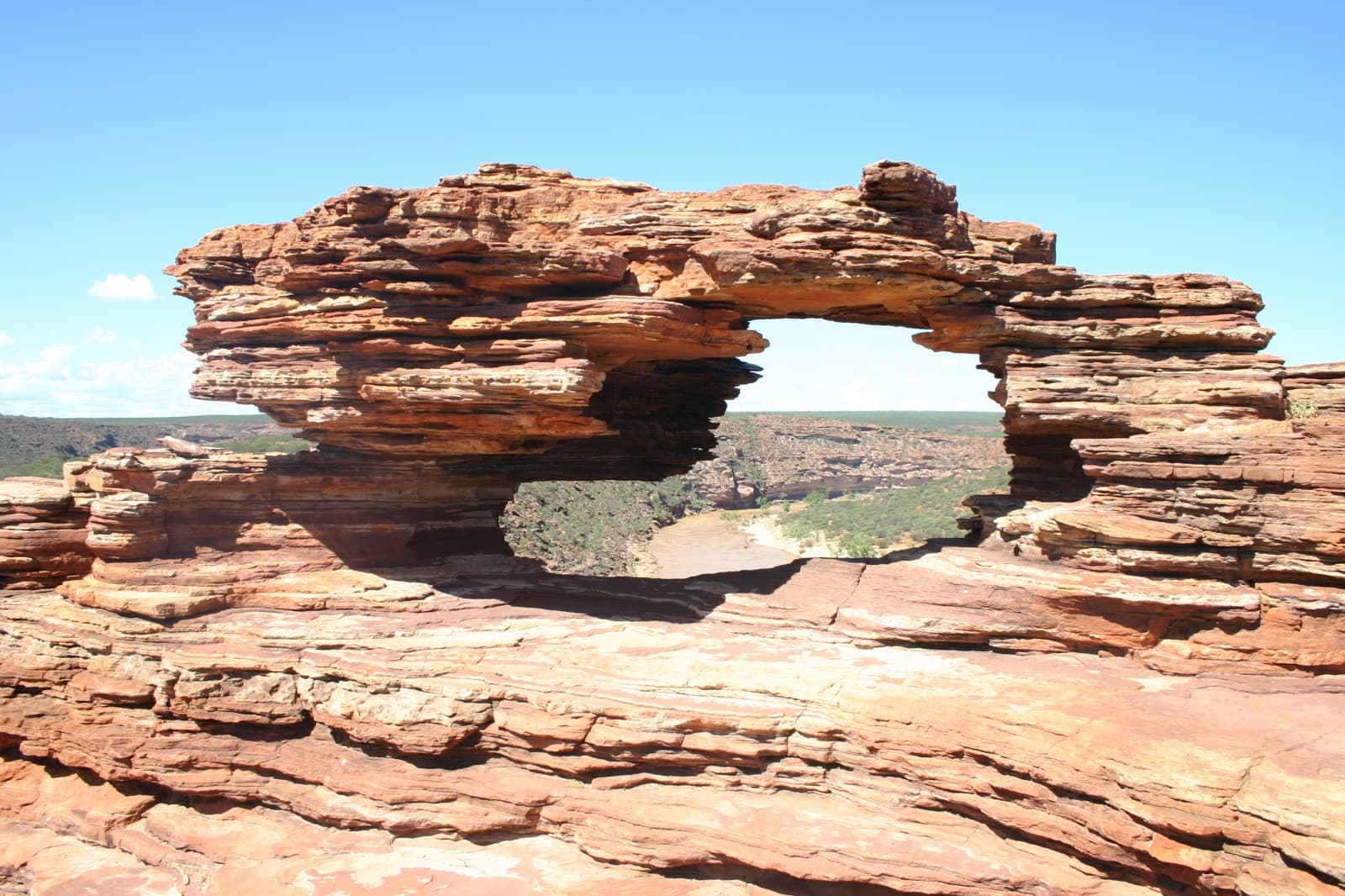
Photo: Takver (Tirin) · CC BY-SA 3.0 · Wikimedia Commons. Source file · CC BY-SA 3.0

Takver (Tirin) · CC BY-SA 3.0
Home / Visitor guides / Plan your visit
Kalbarri National Park is two landscapes sharing one name. Inland, the Murchison River has cut an eighty-kilometre gorge through red and white Tumblagooda sandstone — Nature’s Window, the Loop, Z-Bend, Hawks Head and the twin cantilevers of Kalbarri Skywalk. On the coast, cliffs drop more than a hundred metres to the Indian Ocean at Red Bluff, Eagle Gorge, Island Rock and Natural Bridge. Treat them as separate days and the park becomes simple. Treat them as one blurry “Kalbarri” and you will overpay, overheat or miss the free half of the map.
This is an independent field guide, not Parks and Wildlife. Fees, Loop heat closures and track status change. Check Explore Parks WA and DBCA alerts the morning you go. The park sits on Nanda Country. The town of Kalbarri, at the river mouth, is the only practical base.
Planning your visit
The park covers about 186,000 hectares and sits roughly 590 kilometres north of Perth. All public roads into the main sites are sealed. That fact does more work than most brochures admit: a two-wheel-drive hire car is enough, but caravans and trailers are banned on the inland Loop and Z-Bend roads. Unhitch in town. Fill every bottle in town. There is no drinking water in the park, and the Skywalk kiosk is not a hydration plan.
Give inland gorges the cool hours and the coast the windy afternoon. In summer the gorge can run ten degrees hotter than the town forecast and has reached around 50 °C. The Loop Trail is closed after 7 am from November to March inclusive. Nature’s Window and the Skywalk remain the honest first-day pairing for most visitors. Save the nine-kilometre Loop for a cool morning when you can start early with three to four litres each.
Read the companion briefs on park fees and passes, best time to visit and heat safety and the Loop rule before you lock accommodation.
Park entry fees and what is free
Inland gorge sites use standard Western Australian park entry. Published rates at last check were $17 per standard vehicle per day, $10 concession, $10 for a motorcycle, and a per-person rate for large vehicles. A valid holiday pass covers the same entry. Coastal cliff sites south of town are generally free — no second ticket, and no Skywalk surcharge on top of the inland day fee.
Buy a day pass at the inland entry station, at Parks and Wildlife, or at the Kalbarri Visitor Centre. Multi-day and holiday passes are sold online through the department shop and at some local outlets. We do not sell passes. If a tour desk implies otherwise, walk away. Details live in the fees guide.
Nature’s Window, the Loop and Kalbarri Skywalk
Nature’s Window is the photograph everyone already has on their phone: a wind-eroded opening in layered sandstone that frames a bend of the Murchison. The walk is about 800 metres to one kilometre return, 30–45 minutes, Class 3. It starts with stairs from the Loop car park, then a rocky finish. Stay off the fragile lip of the arch. Full notes: Nature’s Window walk.
The Loop continues from the same car park for nine kilometres and three to five hours. Class 4, limited shade, no water, steep and sandy in sections. It is a proper gorge walk, not a longer version of the Window selfie. In November–March you must start before 7 am or do not start. Read the Loop Trail before you commit.
Kalbarri Skywalk — kaju yatka, “walk to sky” — sits about 37 kilometres from town on the same inland sealed road. Two platforms project 25 and 17 metres beyond the rim, a hundred metres above the gorge. The path from the car park is about 150 metres, level and suitable for many wheelchairs and prams. There is no separate Skywalk ticket. It is accessible day and night but unlit; go in daylight. See Kalbarri Skywalk.
Z-Bend, Hawks Head and Ross Graham complete the inland set. The lookouts are short; the Z-Bend river trail and the 38-kilometre gorge hike are not. Start with the inland gorges overview.
Coastal cliffs — the other park
South of town, George Grey Drive strings lookouts along the sea: Red Bluff, Mushroom Rock, Rainbow Valley, Eagle Gorge, Pot Alley, Island Rock and Natural Bridge. Most are a short stroll from a car park. The Bigurda Trail links Eagle Gorge to Natural Bridge over eight kilometres of cliff-top walking. Coastal sites are generally free and often the better choice on a hot day or when a van is still hitched.
Wave surge has killed people here. Stay on paths and boardwalks. Keep well back from the waterline at the base of cliffs. Pot Alley is a steep, winding road — leave long vehicles out of it. The coastal cliffs guide and Natural Bridge and Island Rock cover the practical splits.
Comfort, safety and what to pack
Heat stress can kill. Carry and drink about one litre per person per hour on gorge walks, more in hot weather. Wear a hat, loose long sleeves and sturdy shoes. Walk early. Tell someone your plan. Consider a personal locator beacon on the Loop or any river trail. Pets are banned everywhere in the park, including inside vehicles — Western Shield 1080 baits are laid for foxes and feral cats.
Pack the boring kit: water, electrolytes, sunscreen, a paper map from the visitor centre, offline maps, a first-aid wrap, and a way to carry rubbish out. Fires are not a casual option; gas cookers are the usual allowance. Full list: what to pack.
How long do you need in Kalbarri?
A single full day from town can cover Skywalk plus Nature’s Window, or a coastal lookout string, but not both at a human pace plus the Loop. Two days is the minimum if you want inland and coast. Three days lets you add Z-Bend or Bigurda and a slow morning for wildflowers in season. Sample days live in the one- and three-day itineraries. Families should read visiting with kids before promising the Loop.
Stay in town, not in the park. The town as a base and camping and accommodation pieces explain unhitch areas, Lucky Bay and why “camping in Kalbarri National Park” is usually a misunderstanding.
Official checks before you leave the bitumen
- Explore Parks WA park page and visitor guide PDF
- DBCA alerts for heat, feral-animal control and road closures
- Kalbarri Visitor Centre for passes, maps and the current wildflower grapevine
- Bureau of Meteorology town forecast — then add a harsh margin for the gorge
- Emergency+ app downloaded while you still have reception
If you only read one page on this site besides this one, make it the heat and Loop rule brief. The sandstone will wait. Heatstroke will not.
Frequently asked questions
- Do you need a park pass for Kalbarri National Park?
- A standard WA park pass is required for the inland river-gorge sites, including Nature’s Window, the Loop, Kalbarri Skywalk, Z-Bend, Hawks Head and Ross Graham. Coastal cliff lookouts south of town are generally free. Confirm live fees on Explore Parks WA.
- How far is Kalbarri National Park from Perth?
- About 590 kilometres north of Perth, typically a six-and-a-half to seven-and-a-half hour drive depending on stops in Geraldton or along the Brand Highway.
- Can you camp inside Kalbarri National Park?
- No casual camping. Sleep in Kalbarri town or at other lawful sites outside the park. Overnight gorge hiking is a tightly controlled exception that needs ranger registration well in advance.