Nature and seasons · 10 min read
Photographing Kalbarri National Park
Window light, Skywalk glare, coastal sunset and the unglamorous rules — stay off the arch, mind the heat, and keep drones inside CASA law and away from people.
Editorial desk · Updated 2026-10-12
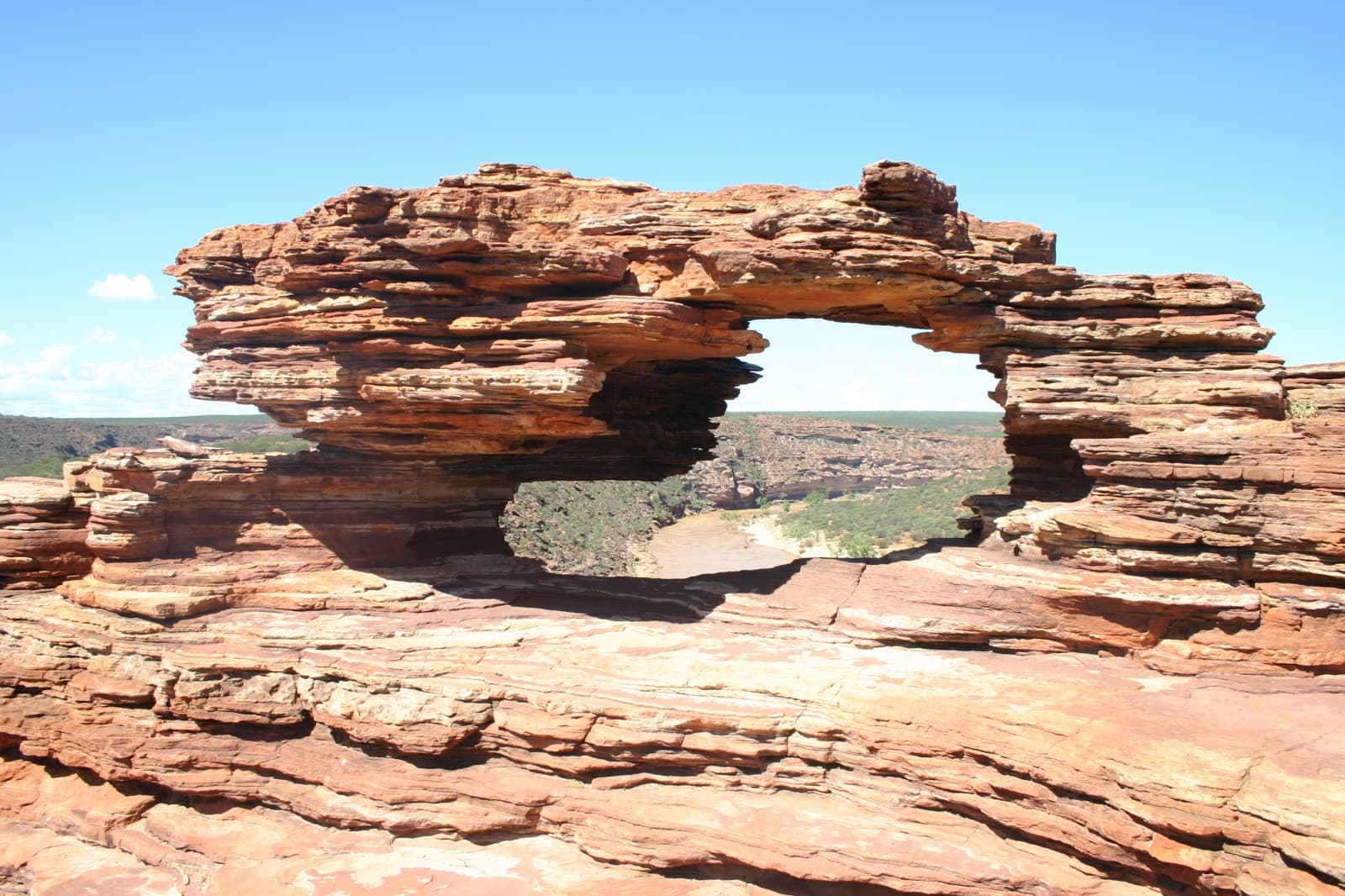
Photo: Takver (Tirin) · CC BY-SA 3.0 · Wikimedia Commons. Source file · CC BY-SA 3.0

Takver / Tirin · CC BY-SA 3.0
Home / Visitor guides / Nature and seasons
Kalbarri photographs too easily and forgives too little. Nature’s Window already looks like a postcard. Kalbarri Skywalk throws steel into empty air. The coastal stacks south of town catch a hard western sun and turn copper. That ease is a trap. People climb the arch, launch drones over prams, and linger on black rock at noon because the histogram looked unfinished.
This is an independent field note, not a workshop brochure. The park is on Nanda Country. You are a guest with a camera, not a permit to rearrange the set. Fees, heat closures and any ban on remotely piloted aircraft change. Confirm the live position with Explore Parks WA and DBCA alerts the morning you go. Inland gorge sites were last checked at $17 a vehicle and $10 concession; the coastal lookouts are generally free. There is no drinking water in the park. Sleep in town, 590 kilometres from Perth, and treat every extra kilogram of glass as water you did not carry.
Nature’s Window — light, not a pedestal
The walk from the Loop car park is short: about 800 metres to a kilometre return, 30–45 minutes, Class 3, stairs then rock. That brevity is why the Window is crowded by nine, and why late arrivals find harsh overhead light and start looking for a higher stance.
Do not stand on the arch, sit on the lip for “scale”, or send a child through the opening. The sandstone is more brittle than a wide-angle implies. The classic frame — river bend held inside an oval of rock — is available from the marked slabs if you wait for people to cycle through. Waiting is part of the craft.
Morning is the honest window. The gorge holds shadow. In winter you can be civil about the queue. In summer the same golden hour is a medical problem: the Loop, which shares this car park, is closed to starters after 7 am from November to March, and the rim can sit many degrees above the town forecast. A 6 am arrival with two litres each is photography. A 10 am arrival with a smoothie is theatre.
Side light rakes the Tumblagooda bands. Midday flattens them into a postcard with white river. If you only have midday, expose for the rock or put the camera away. Walking notes live in the Nature’s Window guide. The Loop is a three-to-five-hour commitment, not a longer foreground.
Skywalk glare and the problem of steel
Kalbarri Skywalk — kaju yatka, “walk to sky” — is a short, accessible walk of about 150 metres from the car park. Two cantilevers project 25 and 17 metres beyond the rim. It is a gift to anyone who cannot scramble, and a headache for anyone who thought glass and metal would behave like rock.
The platforms flare. Midday sun turns the deck into a mirror. Polarising filters help on the river far below and do almost nothing for a person in a white shirt. Early and late are kinder, but the Skywalk is unlit; if you stay for dusk, take a torch and do not treat the glass edge as a tripod.
People are not leading lines. Do not block the only accessible route with a bag of lenses, ask someone to lean out, or fly anything over the deck. The interpretive artwork in the roof is for reading, not for a tight crop you later sell. Guest manners sit in the Nanda Country essay; platform notes sit in the Skywalk guide. The Skywalk and the Window share the inland fee, the sealed road from town, and the same absence of water. Photograph the gorge, then drink what you brought.
Coastal sunset, wind and the surge you cannot see in a still
South of town, George Grey Drive strings coastal cliffs that are generally free: Red Bluff, Eagle Gorge, Island Rock, Natural Bridge and the rest. Sunset here is the obvious luxury. Stacks go dark against a loud sky. You will not need a park pass for these lookouts, which is not the same as being safe.
Wind is the hidden exposure. A light tripod will vibrate itself into mush. Weight the legs. Keep the bag off the cliff-edge vegetation you were about to use as a windbreak. Wave surge has killed people on this coast. The photograph from the waterline is not worth it. Stay on paths and boardwalks.
Colour here is later than inland. The gorge can already be in blue shadow while the sea cliffs are still working. That is an argument for splitting days, not for racing the inland fee and a coastal sunset in one overheated loop. The itineraries are blunt about this. So is one park, two landscapes.
Hutt Lagoon, the pink lake, will try to hijack your shot list. It is not in the national park. Do not file it under “Kalbarri National Park sunset” and then wonder why the inland $17 never applied.
Fragile rock, vegetation and the ethics of a footprint
Stay off the arch, the crusts that look like texture, and the little ledges that “would make a better angle”. Kalbarri’s lookouts exist because enough people already stood in the obvious places. Your originality is not a defence. Do not stack cairns or cut flowers for a foreground. The best time to visit notes are about seasons, not about picking a bouquet.
Tripods on narrow paths are a courtesy problem. Fold them when a family with a pram is coming through the Skywalk. Do not hang a leg over the Window drop for a “fun” wide shot, and do not leave carbon-fibre in the only safe standing room on the coast.
Drones: CASA first, then manners
Remotely piloted aircraft sit under CASA rules whether or not a ranger is watching. Department conditions sit on top of that. For a visitor with a foldable quadcopter: assume you cannot, then prove otherwise from current official text — not from a YouTube clip filmed in 2019.
Do not fly over people. A Skywalk loaded with travellers is a crowd, not a gap. Do not fly over the Window stairs or a beach where kids are swimming. Do not chase birds or launch from a railing. If you lack a commercial licence and a park permit, leave the aircraft in town. A drone over Nanda Country is noise and a claim on air, not a neutral tool.
Golden hour versus heat
Golden hour is a lighting term, not a safety exemption. In the cooler months it is a gift. In the hot months it can sit inside the danger window. The gorge has run around 10 °C above the town forecast and has reached temperatures that make a packed camera bag feel like a bad joke.
Walk early. Carry and drink on the order of a litre per person per hour on any gorge walking beyond a lookout. Wear a hat you can keep on while shooting. There is no water in the park. Toilets at the main inland sites and several coastal car parks are not shade.
The Loop’s 7 am summer rule exists because people thought they were fitter than physics. If you came to photograph the river from inside the gorge, read the Loop trail notes and the visitor guide before you set an alarm. If you came with children, the family brief will tell you to keep the day to the Skywalk and the Window.
You do not need a 12-stop filter set. A mid-range zoom, a wider option for the Window, a cloth for salt and red dust, spare batteries that hate heat, and more water than lens cloths will outperform a bag that needs a trolley. Leave the trolley in town. Unhitch. Buy your pass as described in the fees guide. Do not camp in the park overnight to “be first at the Window”; the accommodation notes exist because that idea keeps circulating.
Shoot less than you think. The Window will still be there if you miss a gap in the crowd. Check the official alerts, then listen to the gorge for a minute without making a file. That minute is the part of Kalbarri that does not fit in a grid.
Frequently asked questions
- Can you fly a drone in Kalbarri National Park?
- Recreational drones in WA national parks are tightly restricted. Follow CASA rules, do not fly over people, and check current DBCA park conditions before you even charge a battery. A lookout full of families is not a launch pad.
- When is the light best at Nature’s Window?
- Early morning is kinder than midday. The sandstone faces east-ish and the gorge floor stays in shade longer than the rim. In summer, golden hour can collide with dangerous heat — the photograph is not worth heatstroke.
- Can you stand on Nature’s Window for the classic shot?
- No. Stay off the fragile lip of the arch. The rock is thinner than social media implies, and the drop is not a special effect. Shoot from the marked approaches and the surrounding slabs.