Coastal cliffs · 9 min read
Natural Bridge and Island Rock
The southern boardwalk pair — a sea stack, a span the ocean is still editing, a Bigurda finish and a sunset that is not worth the waterline.
Editorial desk · Updated 2026-09-18
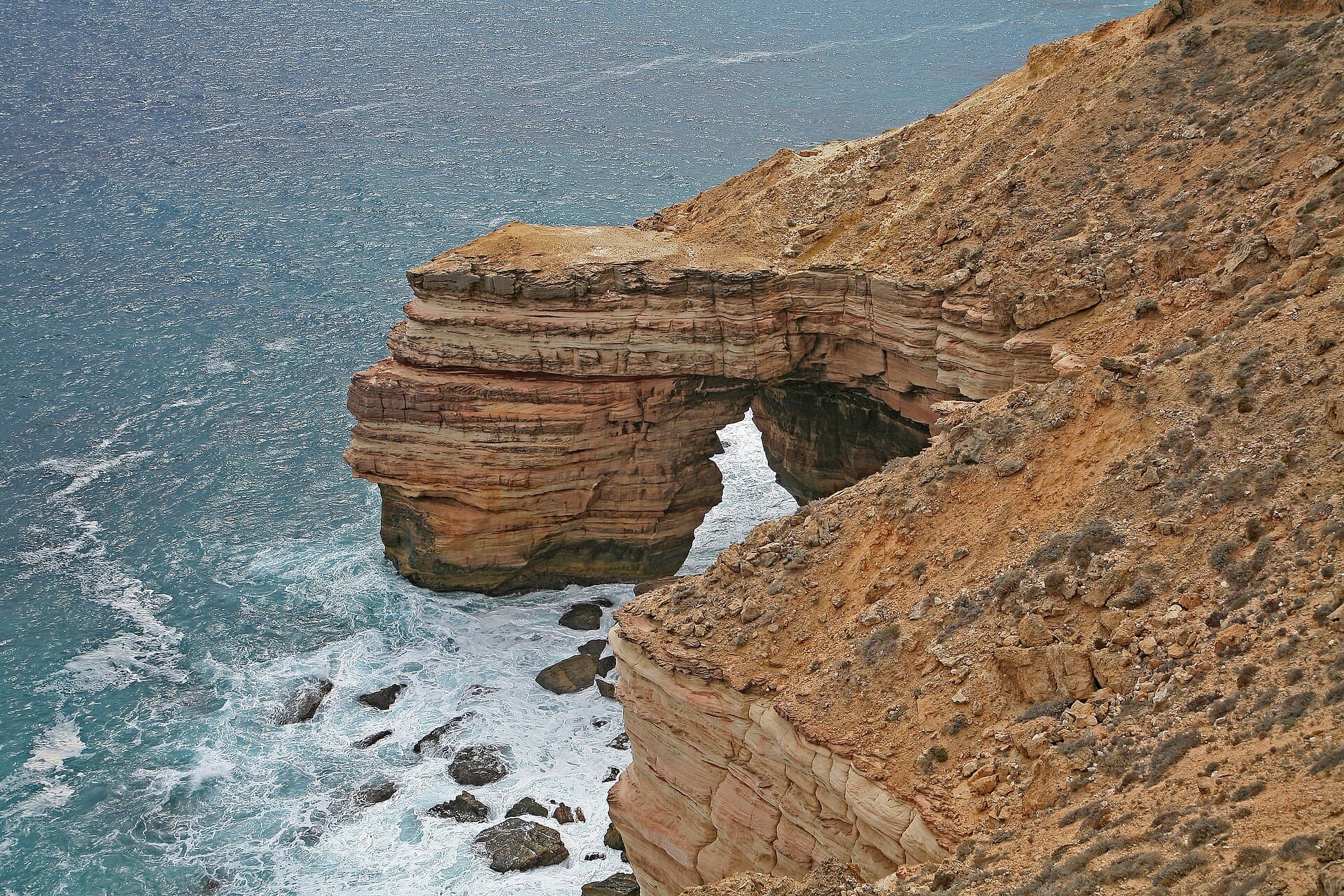
Photo: W. Bulach · CC BY-SA 4.0 · Wikimedia Commons. Source file · CC BY-SA 4.0

W. Bulach · CC BY-SA 4.0
Home / Visitor guides / Coastal cliffs
Island Rock is the stack. Natural Bridge is the span. Together they are the southern full stop on the public coastal string, the place a lot of Kalbarri afternoons are aiming whether people admit it or not. You drive George Grey Drive until the bitumen and the signs run out of further famous names, you park, and you walk a boardwalk to look at two pieces of the continent the Indian Ocean is still taking apart. That is the whole attraction. It is enough. It is also enough to get people killed if they decide the boardwalk is a suggestion.
This journal is not Parks and Wildlife. Confirm closures on Explore Parks WA and DBCA alerts before you go. Kalbarri National Park is on Nanda Country — about 186,000 hectares, 590 kilometres north of Perth. These lookouts are generally free; the inland gorge is not. No drinking water, no casual camping, no dogs. Western Shield 1080 baits are laid here. Lucky Bay camping and Hutt Lagoon, the pink lake, sit outside the park.
Getting there without turning it into a project
From Kalbarri town you drive south. The road is sealed. A two-wheel-drive is enough. Caravans can usually stay hitched for this car park in a way they cannot for Pot Alley or the inland Loop road. If the bay is already full of coaches, wait. Nobody is awarding prizes for the tightest reverse on a cliff-top stub.
You do not need a separate ticket for these lookouts. You do need to understand the rest of the map. If your morning was Nature’s Window or Kalbarri Skywalk — kaju yatka — you should already have handled the inland pass. Last-checked published rates were $17 per standard vehicle and $10 concession. Live numbers sit on the department fee page and in our fees guide. Do not wave a coastal-free afternoon at a ranger on the gorge road.
Pair this stop with the rest of the coastal cliffs if you have the daylight. What does not work is arriving in the last ten minutes of light and scrambling off the path because the car park selfie was not enough.
The boardwalk is the point
The department has put boardwalk and formed path between you and the drop for a reason that is not aesthetic. The cliff edge is undercut. The rock can be undercut. The grass at the lip is not a shoulder. People who step off “just a metre” for a cleaner foreground are standing on a cantilever they cannot see. Use the boardwalk. Use the lookout bays. If a railing is there, it is not a tripod clamp for you to lean past.
Island Rock sits off the cliff as a detached stack — the sea has already won the argument behind it. Natural Bridge is a span that has not finished collapsing. You are looking at two stages of the same process. That is more interesting than most visitor-centre copy admits. You do not need to walk under the bridge or onto the stack to understand it. You need ten minutes of looking, preferably when the light is coming across the face rather than straight down on it.
The lower cliff is often the old Tumblagooda sandstone; the paler cap is a younger coastal limestone. If you have already stood at Nature’s Window, you are looking at a coastal version of the same red-and-white story with a different sculptor. The geology notes will do the rest. Do not hammer a souvenir off the face. Do not stack cairns on the bedding. Photograph the bands. Leave them.
Sunset — how to do it without becoming a statistic
Sunset at Natural Bridge is deservedly popular. The stone holds warmth. The stack goes to a clean silhouette. The sea picks up the last colour. Photographers who have been patient all afternoon get the frame they drove north for. Photographers who have not been patient start hunting a lower angle, a wetter foreground, a place on the wrong side of the barrier where “the sky is better”. That is how ordinary evenings turn into rescue jobs.
Stay on the boardwalk. Stay off the waterline. If you want reflection, use a puddle on the path, not a rock platform the next set might own. If you want people in the frame, put them on the lookout, not on the span. If the wind is hard, shorten the session and hold onto children. A southerly that was pleasant at Red Bluff can be a shove here.
The photography guide is the place for lens notes. This page is for the sentence that should be on every sunset reel: the shot is not worth the surge. Wave surge has killed people on this coast. Arrive a little early. Leave while you can still see your feet. There is no lighting on these paths you should rely on.
The Bigurda finish
The Bigurda Trail links Eagle Gorge to Natural Bridge along about eight kilometres of cliff top. If you have walked it from the north, this boardwalk is the finish — a decent emotional landing after a wind-blown few hours. If you are starting here and walking north, it is a trailhead with a view already in the bag. Either way, the lookout visit and the trail are different decisions. You can have the stack without the eight kilometres. You cannot have the eight kilometres without water, shoes and a weather check.
There is no drinking water in the park. Carry it. The walk is exposed. In flower season — peak August to October — stay on the track rather than braiding new pads through the shrubs. The Eagle Gorge and Pot Alley notes cover the northern end, including why Pot Alley is a poor idea with a van still hitched. Side trips down toward the water turn a marked trail into an unmarked problem.
Stay off the waterline
This warning will sound repetitive if you have already read the coastal overview. Good. The waterline at the base of these cliffs is a surge zone with pretty geology, not a suburban beach. Fishing rock, wet shelves, “just down on the sand for a minute” — they are the same decision. If you want a beach, use a named access with eyes open rather than inventing one under the stack. Assign a sober adult to the group’s edge behaviour. That is how families come back to town.
Practical details people skip
Shoes with grip. Water in the car and on the walk. A layer for the wind. Hats that stay on. No drones unless you have checked the current rules — this journal is not your permit. No fires. No dogs, including “they’ll stay in the van”. 1080 does not negotiate.
The Kalbarri Visitor Centre in town is still the best grapevine for wind, whale months and whether a coach convoy has already claimed the car park. The park phone is 08 9937 1140. For a whole-park frame, use the visitor guide. For when to come, use best time to visit. For Country, use Nanda Country. For the inland contrast the same day, inland gorges.
Natural Bridge will fall one day. That is what bridges of this kind do. Your visit does not need to hurry it, and it does not need to be the last thing you stand on.
Frequently asked questions
- Do you need a park pass for Natural Bridge and Island Rock?
- Coastal cliff sites south of town, including Natural Bridge and Island Rock, are generally free. Inland gorge sites are not. Last-checked inland day rates were $17 per standard vehicle and $10 concession. Verify live fees on Explore Parks WA.
- Is Natural Bridge a good sunset spot?
- Yes, if you stay on the boardwalk and formed paths. The stack and the span take warm light well. It is a poor sunset spot if you wander toward the surge zone for a silhouette at water level.
- Can you walk to Natural Bridge from Eagle Gorge?
- Yes. The Bigurda Trail is about eight kilometres of cliff-top walking between Eagle Gorge and Natural Bridge. The lookouts themselves do not require the walk. Take water — there is none in the park — and check track status on DBCA alerts.