Inland gorges · 10 min read
Tumblagooda sandstone and Kalbarri geology
How to read the red-and-white gorge walls, why Nature’s Window is a hole in a fin of rock, and why the coastal cliffs wear a younger limestone cap — without hammering a single sample.
Editorial desk · Updated 2026-09-18
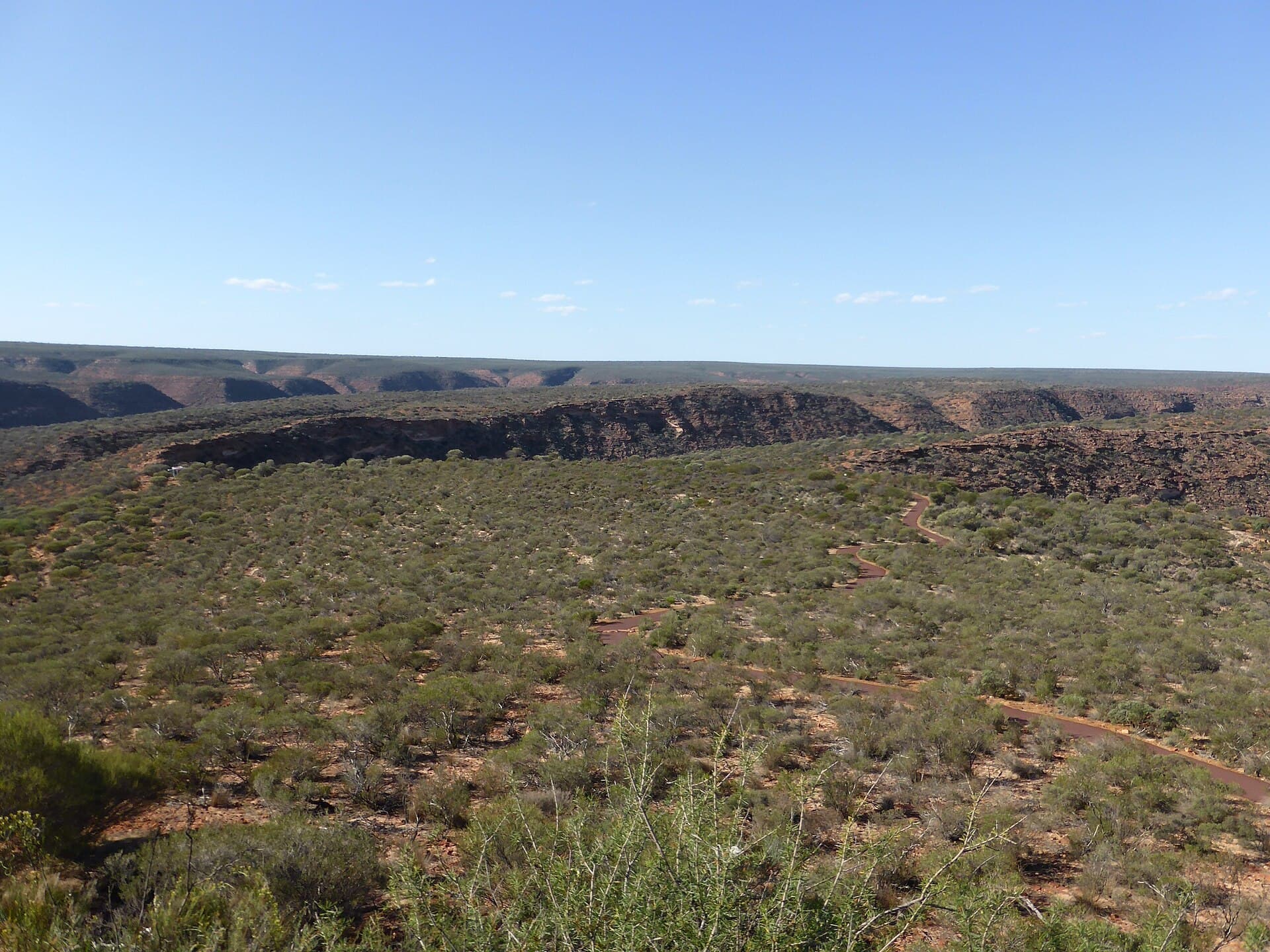
Photo: Bryn Pinzgauer · CC BY 2.0 · Wikimedia Commons. Source file · CC BY 2.0

Bryn Pinzgauer · CC BY 2.0
Home / Visitor guides / Inland gorges
The first useful thing to do at Kalbarri is not to take the photograph. Stand on the rim at Nature’s Window, or on a cantilever at Kalbarri Skywalk — kaju yatka, “walk to sky” — and look at the wall opposite. The gorge is not a single red cliff. It is a stack of pale and iron-stained beds, some even as a layer cake, some cross-bedded like a frozen current. That pattern is the Tumblagooda sandstone.
Kalbarri National Park sits on Nanda Country. The park covers about 186,000 hectares and lies roughly 590 kilometres north of Perth. This journal is independent of Parks and Wildlife. Fees, closures and track status change. Check Explore Parks WA and DBCA alerts the morning you drive inland. Do not hammer the rock. Do not take a souvenir. The geology is the attraction; removing it is vandalism dressed as curiosity.
What visitors are actually looking at
Tumblagooda sandstone is the rock that gives Kalbarri its postcard colour. Inland, the Murchison River has cut an eighty-kilometre gorge through a plateau of it. On the coast, the same formation often forms the lower cliff, with a younger pale limestone cap sitting on top like a different book stacked on an older one. The red-and-white banding people remember from the Window car park is iron. Where groundwater and air have oxidised iron minerals, the sand turns rust-red. Where it has not, or where later bleaching has worked, the same sand stays pale. The bands are not painted stripes. They are a chemical history you can read from a lookout without a degree.
The sand itself was laid down around 400 million years ago in a world without flowering plants. Think shallow seas, tidal flats and river mouths. Currents stacked the grains in cross-beds that still show on the gorge walls if the light is low. A late-afternoon walk at the inland gorges beats a midday blast of glare. The visitor guide will get you to the car parks. This piece is for the half-hour you spend looking once you are there.
Trace fossils — the marks, not the bones
Kalbarri’s famous fossils are mostly traces: burrows, trackways and feeding scribbles left in wet sand and then buried. They are not dinosaur bones. They are older than dinosaurs. A vertical pipe in the rock may be a worm burrow. A ridged trail may be the path of an arthropod walking across a tidal flat. Some of the better-known traces from this formation have been argued over for decades — which animal, which environment — and that argument is not something a lookout sign can settle. For a visitor, the useful fact is simpler. Life was already busy here when this sand was still loose. The animals are gone. The marks remain.
You will not always see them. Many faces are too high, too weathered, or simply in the wrong light. Do not chip at a ledge to “find” one. Look from the path. The photography guide is a better companion than a geology hammer. People who expect a labelled museum slab by the car park have come to a landscape, not a quarry.
Why Nature’s Window exists
Nature’s Window is a hole in a thin fin of sandstone on the rim of a river bend. Wind, grit and rain have exploited joints and weaker beds until the fin perforated. The opening frames a loop of the Murchison because the river happens to swing beneath that particular weakness. If the joints had run differently, you would have a solid wall and a different postcard. There is no architect. There is also no spare Window. The lip is thin. People climbing onto it for a better angle are standing on the thing they came to see.
The walk from the Loop car park is short — in the order of 800 metres to a kilometre return — and still enough to twist an ankle if you treat the last rocky section like a footpath in a city park. Inland gorge sites use a standard Western Australian park entry. Published rates at last check were $17 per standard vehicle per day and $10 concession. Confirm live figures on park entry fees and in our fees guide. Coastal lookouts south of town are generally free. The Window is not a coastal lookout. Budget for the inland pass.
The same sandstone that makes the Window makes the Skywalk’s view. kaju yatka puts you out over the drop on steel, which is a blessing for anyone who does not want to stand on an eroded lip. Use the engineered platform for the wide shot. Use the Window for the framed shot. Use neither as a climbing wall. The rock is old. It is not immortal.
The coastal limestone cap
Drive George Grey Drive south of town and the cliffs tell a two-part story. The lower, warmer-coloured rock is often still Tumblagooda. The pale cap is younger coastal limestone — a different chapter, laid down when this edge of the continent was dealing with dunes, shell and the more recent sea. That is why a cliff can look red at the base and cream at the brow, and why a sea stack can seem to wear a hat. The ocean is now the sculptor the river was inland. Wave surge, not a summer creek, does the cutting.
Inland you are looking into a river trench cut through a sandstone plateau. On the coast you are looking at that plateau meeting the Indian Ocean, with a later limestone skin along the top. Pair a morning at the Window with an afternoon at Natural Bridge and Island Rock. The coastal cliffs guide covers the lookout string and the surge warning. Geology is not an excuse to walk down to the waterline.
Hutt Lagoon — the pink lake near Port Gregory — is not in the national park. Lucky Bay camping is likewise outside the boundary. There is no casual camping in the park. Sleep in town.
Do not hammer the rocks
It should not need saying, and it always needs saying. National park rock is not a sample bag. Hammers, chisels, screwdrivers and “just a small piece for the classroom” are the same act. The bands you came to photograph are the bands someone else will not see if you take them home. Trace fossils are easy to destroy and impossible to put back. Even sitting on the Window lip, even scratching a name, even stacking cairns on a bedding plane, changes the thing.
Take photographs. Take notes. Take your rubbish. Leave the stone. Parks and Wildlife can be reached on 08 9937 1140 if you need a live ruling. We are not the department. A polite journal voice does not make collecting legal.
How to spend a geology day without overheating
Give the gorge the cool hours. In summer the inland country can run far hotter than the town forecast. There is no drinking water in the park. Fill every bottle in Kalbarri. Pets are banned, including inside vehicles — Western Shield 1080 baits are laid for foxes and feral cats. Caravans and trailers are banned on the inland Loop and Z-Bend roads; unhitch in town. The Loop Trail has a summer start rule. Do not invent a geology exception.
A sane day is Skywalk plus the Window, then a late coastal string if the wind is kind. That gives you the banded walls, the perforated fin and the limestone-capped sea cliffs before anyone is tempted to walk the nine-kilometre Loop in the heat. Read best time to visit before you lock the week. Wildflowers peak August to October on this plateau — stay on formed tracks so the living skin survives the old floor.
Country, names and what this journal will not invent
Nanda people are the Traditional Owners of this country. We use kaju yatka because it is the place name, not because a journal gets to summarise culture for atmosphere. We do not invent ceremony or unofficial translations. Read Nanda Country.
The rock will outlast your booking. Heatstroke will not wait. Look at the bands. Leave the hammer in the shed. Verify fees and alerts before you leave the bitumen.
Frequently asked questions
- How old is the sandstone in Kalbarri National Park?
- The Tumblagooda sandstone that makes the inland gorges and much of the coastal cliff face is in the order of 400 million years old — late Ordovician to early Silurian in the usual telling. Dates get refined; the visitor takeaway is that you are looking at a very old shallow-sea and river sand, not recent red dirt.
- Why is Nature’s Window a hole in the rock?
- It is a wind-eroded opening in a thin fin of Tumblagooda sandstone on the gorge rim. Joints and weaker beds let the wind and grit chew through. It is not a constructed arch and it is not a climbing frame. Stay off the fragile lip.
- Can you collect rocks or fossils in Kalbarri National Park?
- No. Do not hammer, scrape or pocket samples. Trace fossils and the banded faces are part of the park. Photograph them, then leave them. Confirm current rules on Explore Parks WA.