Walks and trails · 11 min read
The Loop Trail, Kalbarri
Nine kilometres of Class 4 gorge walking from the Nature’s Window car park — distance, the 7 am summer start, water and shade, and who should skip it.
Editorial desk · Updated 2026-10-08
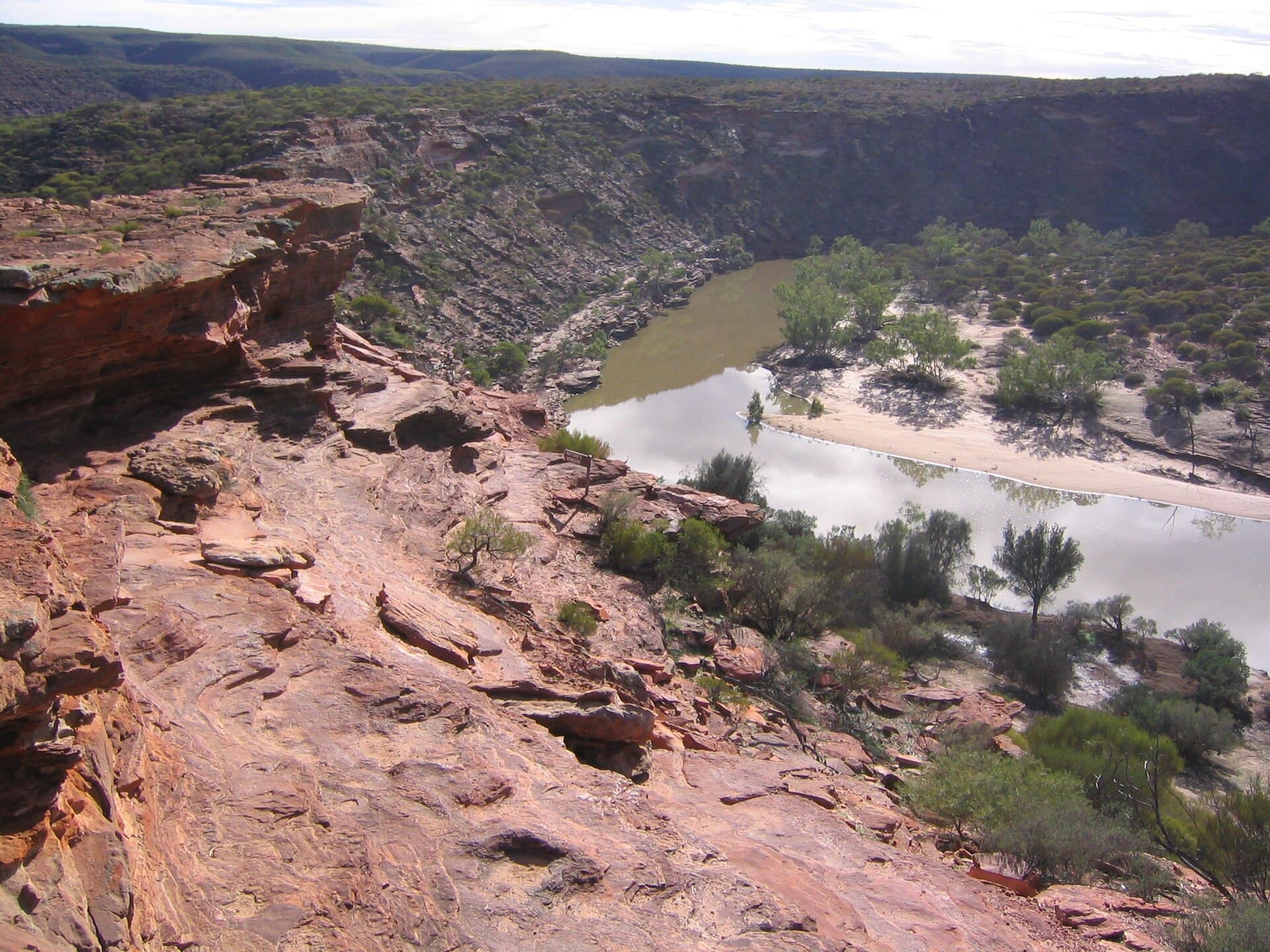
Photo: Phil Whitehouse · CC BY 2.0 · Wikimedia Commons. Source file · CC BY 2.0

Phil Whitehouse · CC BY 2.0
Home / Visitor guides / Walks and trails
The Loop is the walk Kalbarri first-timers promise themselves after Nature’s Window, and it is the walk most of them should postpone. Nine kilometres. Three to five hours. Class 4. No drinking water. Little shade. A gorge that can run around 50 °C. From November to March inclusive you start before 7 am or you do not start. That is how people stay out of trouble on Nanda Country.
This is an independent journal, not Parks and Wildlife. Confirm the live rule on Explore Parks WA and DBCA alerts the morning you set the alarm. The inland day fee — last-checked $17 a standard vehicle, $10 concession, $10 a motorcycle — gets you into the precinct. It does not make the circuit safer. Read heat safety and the Loop rule before you pack, and what to pack before you leave town.
How long is the Loop walk
Nine kilometres is the figure to plan around, and three to five hours is the time. Fit walkers on a cool July morning sit at the short end. Holiday walkers on a warm shoulder-season day, stopping at the river, sit at the long end. Heat stretches the walk in ways that have nothing to do with fitness.
The circuit starts and finishes at the Loop car park, the same inland node as Nature’s Window. You can walk to the arch first — 800 metres to one kilometre return, 30 to 45 minutes, Class 3 — then continue. You cannot count the Window time as the Loop time. They are nested, not equal.
There is no drinking water on the trail. This is gorge walking: stairs, rock, sand, and a climb that arrives when you are already tired. Allow the whole morning. Dogs are banned everywhere, including vehicles, because of 1080 baiting. Towing is banned on the Loop and Z-Bend roads. Unhitch in town. Fill bottles. Then start.
Class 4 difficulty
Class 4 in the Australian walking system means steep, rough, possibly unmarked in sections, and a need for experience and a decent level of fitness. The Loop earns it. There are sandy stretches that eat energy. There are rocky scrambles that ask for hands. There are exposed benches where the sun has no interruption. It is not a longer Nature’s Window. It is a different class of day.
If your recent walking is coastal boardwalks and the Skywalk’s 150-metre wheelchair-friendly path, you are not trained for this. If you hike regularly and start early with enough water, the Loop is a satisfying circuit. The difference is preparation, not bravery.
Z-Bend lookout is about 1.2 kilometres and the river trail is 2.6 kilometres — a better “are we gorge people?” test. Ross Graham is about 700 metres. Bigurda, on the free coast, is eight kilometres from Eagle Gorge to Natural Bridge: wind and cliff, not trench heat. TrailsWA — trailswa.com.au — will give you the grade. Worn shoes with grip are not optional.
The 7 am summer start
From November to March inclusive, the Loop is closed after 7 am. Arrive, start walking, be on the trail before seven. Standing in the car park at 7:05 with your boots on does not count. Rangers close it because the gorge becomes a kiln and the walk cannot be finished before the worst hours if you begin late.
Summer starts mean a dark departure from town. The Skywalk is 37 kilometres out and on the way; resist “quickly seeing the platforms” unless you will still be walking the Loop before seven. The platforms are open day and night, unlit, and they will wait. The cut-off will not.
If you miss seven, do Nature’s Window if you still have cool, then the Skywalk, then the coast. Confirm the current wording on the alerts page. Winter and the shoulder months without the 7 am gate are the civilised time: a human hour, the Window without a queue, and river time before the day has an edge.
Water shade and turnaround points
Carry about one litre per person per hour, more in heat, which on this walk means three to four litres each as a starting load. Drink before you feel clever. Eat something salty. Frozen bottles help at the car park and become warm ballast later, which you will still want.
Shade is scarce. Use a rock wall, a rare shrub, your own hat brim. The river is not always a place you should wade. Turn around the moment the day is going wrong. Watch the group. The person who has gone quiet decides the next ten minutes.
A practical turnaround for unsure groups is Nature’s Window itself. Walk the Class 3, sit, drink, and only continue if everyone still wants the Class 4 and the clock allows it. The Nature’s Window walk is written so you can make that choice without shame.
If someone is struggling, stop, shade, cool, and treat it as an emergency sooner than optimism prefers. Reception is unreliable. Carry a PLB. The park office is 08 9937 1140. Triple zero is the number that matters when a person is confused or down.
Who should skip it
Skip the Loop if you cannot start before seven in the November–March window, if you have not carried three litres on a walk before, or if anyone will “wait at the Window” for four hours. Skip it with small children you would have to carry, with dinner shoes, after a 590-kilometre drive from Perth, or if the Bureau looks merely warm and you have never felt dry-country heat on rock. Skip it if the group argues instead of turning around.
The Skywalk, the Window, Z-Bend lookout, Hawks Head, Ross Graham, Meanarra Hill at 207 metres above sea level, and the free coastal cliffs are a full visit without this circuit. The inland gorges overview will fill a week. The Loop is a bonus for a prepared morning, not the entry fee to having been here.
Linking the Window and the Loop
The cleanest link is simple. Park once. Walk to Nature’s Window first, while your legs are fresh and the light is low. Take the photograph without standing on the lip. Drink. Decide. If the decision is yes — cool day or a legal pre-7 am summer start, water on your back, group willing — continue onto the Loop and treat the arch as the first chapter, not the whole book.
If the decision is no, return up the stairs and drive to the Skywalk or back to town. You have used the inland pass well. Do not do the Loop first and “see the Window if we have time”. Fatigue makes people sloppy on the rock everyone is photographing. Do not split the party.
Check alerts the night before. Display the pass. Leave dogs and vans in town. Carry the water. Tell someone your plan. Walk on Nanda Country as a guest who intends to come back up the same stairs. The Loop is a fine walk when it is the walk you chose.
Frequently asked questions
- How long is the Loop walk in Kalbarri National Park?
- Nine kilometres, usually three to five hours depending on heat, sand and how long you spend at the river. It is a Class 4 circuit from the same car park as Nature’s Window, not an extension of the 30-to-45-minute arch walk. There is no drinking water on the trail.
- Can you walk the Loop in January?
- Only if you start before 7 am. From November to March inclusive the Loop is closed after seven because the gorge can approach 50 °C. If you cannot leave the car park before that time, do Nature’s Window or the Skywalk and save the circuit for a cooler month.
- Is the Loop harder than Nature’s Window?
- Yes. The Window is Class 3 and about a kilometre return. The Loop is Class 4, nine times the distance, with steep and sandy sections and little shade. Fitness for the Window stairs is not evidence you should continue around the river. Read both walks as separate decisions.