Plan your visit · 10 min read
Kalbarri heat safety and the Loop rule
Why the Murchison gorge runs hotter than town, what the 7 am summer Loop closure actually means, and how to carry water and get help if someone is struggling.
Editorial desk · Updated 2026-09-22
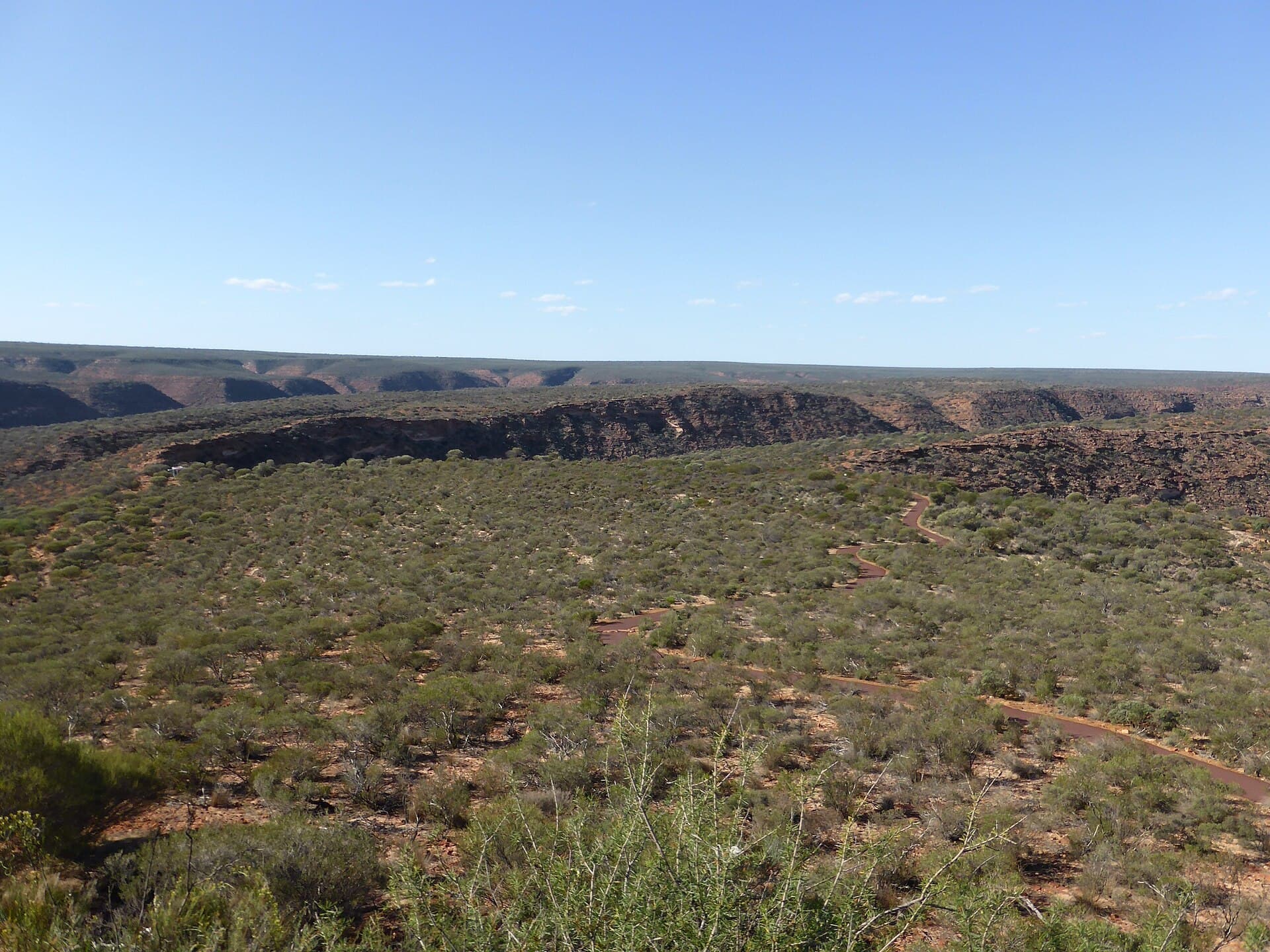
Photo: Bryn Pinzgauer · CC BY 2.0 · Wikimedia Commons. Source file · CC BY 2.0

Bryn Pinzgauer · CC BY 2.0
Home / Visitor guides / Plan your visit
Kalbarri National Park is Nanda Country, and the Murchison gorge does not care that the town forecast looked friendly over toast. Inland rock stores heat. The bend that looks photogenic from Nature’s Window can sit around 50 °C when the coastal breeze is still pretending to help. People pack for a holiday town and walk into a different climate.
This is unofficial writing, not a medical manual and not Parks and Wildlife. Read Explore Parks WA and DBCA alerts the morning you go inland. Treat every litre and clock time here as a conservative field note. The Loop Trail and what to pack sit beside this page.
Why the gorge is hotter than town
Town sits at the river mouth with a sea influence. The inland gorge is a stone trench. Once the sun is on the sandstone bands, walls and sandy benches radiate. A town reading in the low thirties can be a gorge day in the forties. The gap of about ten degrees is enough to turn a “we will be fine” walk into a medical problem.
There is no drinking water in the park and little reliable shade on the Loop. The Skywalk platforms — 25 metres and 17 metres out, a hundred metres above the river — feel airy, but the car park still sits on the same hot plateau. Coastal cliffs are often the better hot afternoon because the wind has somewhere to come from. A dip at the river mouth does not train you for a Class 4, nine-kilometre circuit. Treat inland as a sunrise job in the warm months.
The 7 am Loop rule November to March
From November to March inclusive, the Loop is closed after 7 am. Start before seven or do not start. Rangers are not running a suggestion scheme. The walk takes three to five hours. A 7:30 am start puts you on the hottest rock with the least shade and a long way from the car.
Nature’s Window is not the same rule. The Window walk is 800 metres to one kilometre return, 30 to 45 minutes, Class 3. You can still do it later than the Loop, and you should still do it early. The Skywalk path is about 150 metres and wheelchair-friendly. Those are the inland options when you sleep in. They are not a loophole that lets you “just continue around the Loop” because you already paid the inland fee.
The fee, last-checked at $17 a standard vehicle, $10 concession and $10 a motorcycle, does not buy a heat exemption. Confirm the current closure language on Explore Parks WA and the alerts page before you set an alarm. A bad season can tighten a rule. A mild March does not repeal it.
If you cannot leave the Loop car park before seven in those months, change the day. Drive to the Skywalk, walk the Window, or spend the morning on the free coast. Pride is a poor reason to become a rescue.
How much water to carry
Carry and drink about one litre per person per hour on gorge walks, more when it is hot. For the Loop, that is three to four litres each as a serious starting load, not a two-litre bottle “for the family”. For Nature’s Window, still take more than a mouthful. Short walks become long sits when someone feels crook on the rock.
Fill every container in town. The Skywalk kiosk is not a hydration plan. Hawks Head and Ross Graham do not fix a dry pack. Frozen bottles help for the first hour and then become warm water you are still glad to have. Electrolytes are useful if you sweat hard; they are not a substitute for volume.
Food matters more than people admit. A salty snack and something easy to eat will keep you putting water in. Alcohol the night before is a poor pre-hike plan in this climate. So is a big cooked breakfast that sits like a stone on the first climb. Eat light, drink early, and do not wait for thirst. Thirst is late news in dry heat.
Leave spare water in the car for the return, in the shade, not on the dashboard. A hot car turns a reserve into tea. The packing list is dull on purpose. Dull kit keeps people upright.
Heat stress signs
Heat exhaustion and heat stroke are not the same, and you do not need the textbook names to act. Warning signs we take seriously on this desk: a walker’s pace falling away without a reason, unusual quiet, irritability, headache, nausea, dizziness, cramps, a stop in sweating when they should be wet, confusion, or a claim that they are “fine” while they are no longer making sense.
Children may simply sit down and refuse. Older walkers may insist on “pushing through” because they grew up in warm places that were not a 50 °C gorge. Neither story is a diagnosis. Both are a reason to stop, get into what shade exists, and reassess whether the car is the only safe destination.
Do not wait for collapse. The Loop has sections where turning around is still a long job. If two people are arguing whether the third is “just tired”, the tired one is the priority. This is not a complete medical list. Refresh first-aid guidance before you travel; we are not replacing a clinician.
What to do if someone is struggling
Stop walking away from the car. That sounds obvious and is the mistake: people keep going toward a lookout because it is “not far”. Get the person into shade — a rock overhang, a hat tent, the lee of a shrub, your own bodies — and take off excess packs and tight layers. Cool the skin with water if you have enough to spare. Fan. Sit them down. Do not send them back up a stair alone.
If they can drink, let them drink. If they are confused, vomiting, or not sweating, treat it as an emergency, not a rest stop. Use a PLB if you have one and you are in doubt. If you have reception, call triple zero. If you do not, sending a fitter person toward reception or the car only works if they know exactly where you are and the struggling person is not left alone in the sun.
Do not offer the Loop as a character test. Turn around early and call it a good decision. The Nature’s Window walk is the honest consolation prize: you still saw the arch, you still paid the inland fee, and you did not turn a holiday into a helicopter.
Once you reach the car, air-conditioning is a tool, not a victory lap. Keep cooling, keep sipping, and get to town. The park office number is 08 9937 1140 for park operations; it is not a substitute for emergency services when someone is acutely unwell.
PLBs and reception
Assume the gorge will not carry your voice. Mobile reception on the inland road is patchy and in the trench it can vanish. Download maps in town. Screenshot the car-park name. Tell a person who is not on the walk what you are doing and when you will call from town. If you miss that call, they should worry.
A personal locator beacon is a sensible extra on the Loop, the Z-Bend river trail, or any walk that takes you out of shouting distance of a car park. Hire or buy before you need it. Know how it works in daylight, with dry hands, not for the first time on a hot rock. A charged phone in a Faraday-pouch of a car is not a beacon.
Emergency+ is worth downloading while you still have reception. A paper map from the visitor centre still helps when the phone overheats and shuts down — and phones do that in this park. Carry the park office number, but understand that a closed Loop gate and a medical emergency are different phone calls.
Dogs cannot come to “keep someone safe”. Pets are banned everywhere, including vehicles, because of 1080 baits. Walk with a group that will turn around.
The sandstone will wait. Heat stroke will not. Check the alerts page, start the Loop before seven in the warm months or skip it, and carry the water you would have mocked in Perth.
Frequently asked questions
- Why is the Loop closed after 7 am in summer?
- From November to March inclusive, Parks and Wildlife close the Loop after 7 am because the gorge can reach around 50 °C with almost no shade and no drinking water. The nine-kilometre Class 4 circuit takes three to five hours, so a late start puts people on hot rock in the middle of the day. Nature’s Window and the Skywalk are the inland alternatives if you miss the cut-off.
- How much water should you carry in Kalbarri National Park?
- On gorge walks, plan around one litre per person per hour, more in hot weather, and carry it from town because there is no drinking water in the park. For the Loop that means three to four litres each as a starting point, not a shared family bottle. Short lookouts still need a bottle each. Verify any seasonal advice on Explore Parks WA.
- Is there mobile reception on the Loop?
- Do not plan on it. Reception is unreliable in the gorge and patchy on the inland road. Tell someone your route and return time before you leave town, carry a charged phone for the car park, and consider a personal locator beacon on the Loop or the Z-Bend river trail. The park office number is 08 9937 1140, which only helps if you can make a call.